

Is Ellington a good developer?
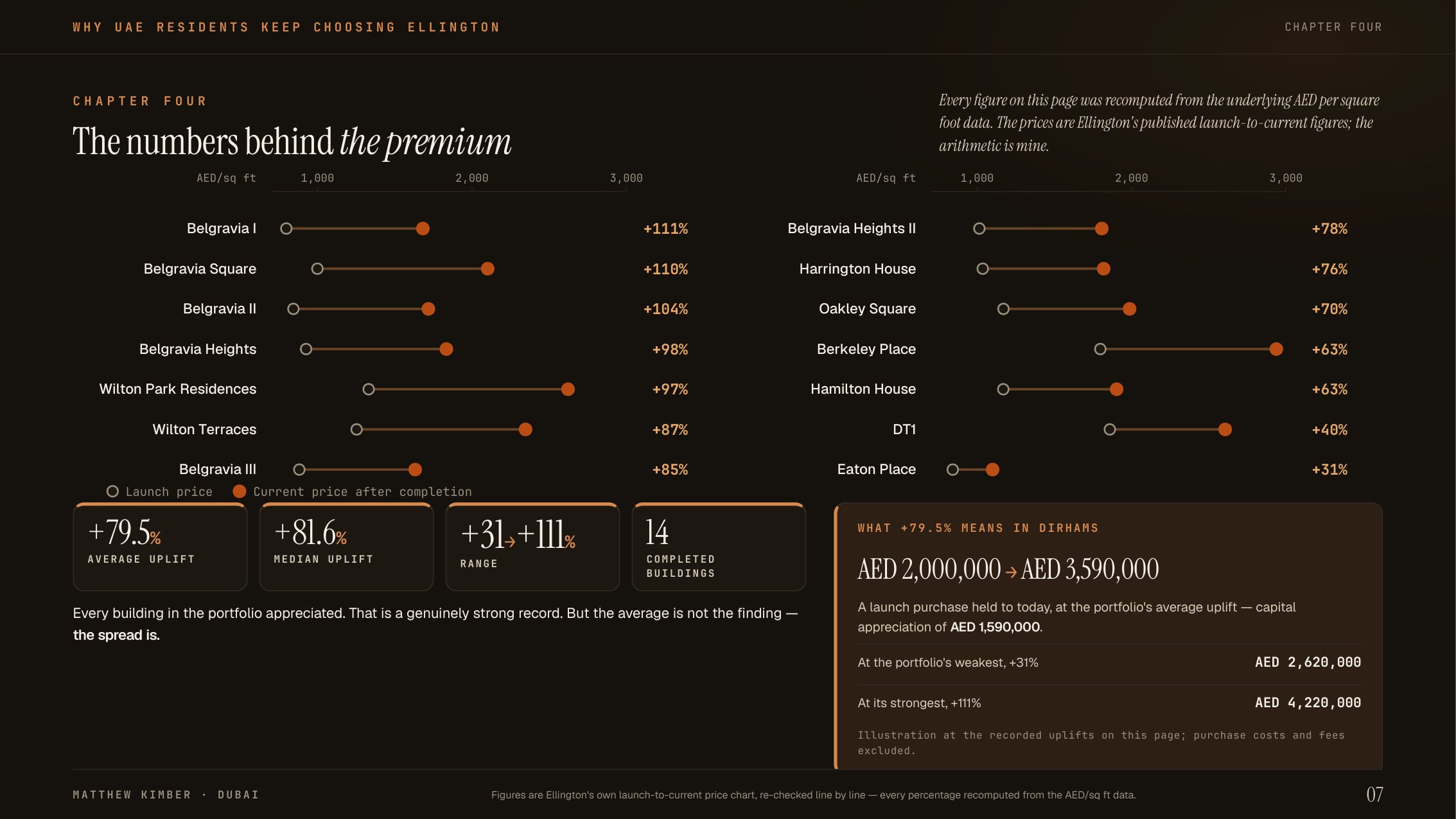
On the recorded evidence, yes — Ellington is one of the strongest boutique developers operating in Dubai, and it is the completed buildings, not the brochures, that say so. Across 14 completed buildings analysed for Publication Nº 01 of this research series (July 2026), the recorded launch-to-current uplift averages +79.5%, the median building sits at +81.6%, and the spread runs from +31% to +111% between the weakest and strongest performer. Figures are Ellington's own launch-to-current price chart, re-checked line by line.
What is Ellington, exactly? A boutique, design-led Dubai developer that competes on product rather than volume — interiors, light, layouts and amenity design that people genuinely want to live in. That positioning is not cosmetic; it is a commercial mechanism. Product that owner-occupiers want creates tenant demand, tenant demand supports occupancy, and occupancy supports the thing most off-plan buyers underweight: how the building reprices once it is finished and the market can walk through it.
My figures are one record. There is also a third-party one. The Oliva developer profile, March 2026, referencing DLD transaction records and RERA filings, records:
- 88% on-time delivery
- 10-18 snagging defects per unit, against a 20-30 Dubai median
- 5-12% resale premium within two years of handover
- 15-25% price premium over community average
Read those four lines together and the shape of the developer appears: Ellington delivers close to on time, hands over cleaner than the market norm, gets repriced upwards after handover — and charges for all of it up front. That last line is where the real investment question begins, and it is the same question I put to every name in my developer due-diligence framework: a good developer is necessary. It is nowhere near sufficient.
Is Ellington worth the premium?
Often — but the recorded spread is the proof that the name alone decides nothing. If the logo guaranteed the outcome, fourteen buildings from the same developer would not range from +31% to +111%. They do. The premium is worth paying when the specific building, the location and the entry price line up behind it, and not otherwise.
Take the two ends of the recorded range. Eaton Place rose +30.6%, from AED 842 to AED 1,100 per square foot — a perfectly respectable result, and the honest floor of the range. Belgravia I rose +110.8%, from AED 798 to AED 1,682 per square foot, with Belgravia Square alongside it at +110.4%. Two buildings, one developer, launched at nearly identical prices per square foot — and one produced more than three times the uplift of the other. Nothing about the logo explains that gap. Location, product-to-area fit and entry price do.
In dirhams, at the recorded uplifts (purchase costs and fees excluded): AED 2,000,000 placed at launch becomes AED 3,590,000 at the average — appreciation of AED 1,590,000. At the weakest building's +31%, the same capital becomes AED 2,620,000. At the strongest building's +111%, it becomes AED 4,220,000. The distance between the best and worst outcome on identical starting capital is AED 1,600,000 — which is why building selection inside a good developer matters more than the decision to buy the developer at all.
So the answer to “is the premium worth it” is conditional, and the conditions are knowable in advance: a location whose fundamentals can carry premium pricing, a product genuinely differentiated from what surrounds it, and an entry price that leaves the next buyer room to pay you more. When those three align, the recorded numbers say Ellington rewards you disproportionately. When they do not, you have bought a beautiful building at a price the area cannot yet support.
Considering Ellington?
I specialise heavily in Ellington and can help you understand which opportunities currently make the strongest investment case — and where I would be more cautious. You do not need unit details to start the conversation; a budget and an objective are enough.
Speak with Matthew about EllingtonOr read how I advise investors first.
Where Ellington is strongest — and where I get cautious
Ellington's strength is concentrated in the things a developer controls. The risk sits almost entirely in the things the buyer controls. The strengths first:
- Delivery and handover quality. The third-party record above — 88% on-time delivery, 10-18 snagging defects per unit against a 20-30 Dubai median — is the mechanical basis for trusting the product you are promised.
- Post-handover repricing. Design-led stock tends to be re-rated once it is real and walkable; the recorded 5-12% resale premium within two years of handover is that mechanism showing up in actual transactions.
- Demand quality. Product people want to live in rents more easily and resells more easily. I publish no Ellington rental figures in this article — those are reserved for a future edition — but the mechanism is the point: the tenant profile a building attracts drives everything downstream of it.
- Depth of record. All fourteen analysed buildings sit in positive territory, from +31% at the floor to +111% at the top. Mid-table examples: DT1 at +40.2%, Wilton Park Residences at +97.0%.
Now the caution, in my own words from the publication: “The times I've told a client to walk from an Ellington building, the building itself was almost never the problem. Wrong price. Wrong stack. Wrong point in the cycle.” Those three failure modes are worth taking one at a time — plus a fourth that rarely makes the brochure:
- Wrong price. The recorded 15-25% premium over community average has to be underwritten by the location's fundamentals. In a maturing area with deep demand it is defensible. In an unproven pocket it is the first thing the resale market refuses to pay you back for.
- Wrong stack. Floor, view and layout decide resale within the same building. The Eaton Place-to-Belgravia spread exists between buildings; a comparable spread exists inside buildings, between the stack that sells in a week and the stack that sits.
- Wrong point in the cycle. Buying after the repricing has happened converts a growth asset into a fully-priced one. The uplifts above accrued to launch buyers — not to whoever paid the post-handover price for the same key.
- Running costs. Amenity-rich, design-heavy buildings carry higher service charges than commodity stock. That is a mechanism, not a scandal — but it must be modelled into net yield before you believe any gross number you are quoted.
None of those four is an argument against the developer. They are an argument against buying the developer on autopilot. Every one of them is checkable before you sign — against the community's completed comparables, the building's stack pricing, and where the area sits on its own repricing curve — and checking them is the difference between owning Belgravia I's outcome and Eaton Place's.
My Ellington Investment Test
This is the Kimber Framework — the ten-question test introduced in Publication Nº 01 — applied the way I actually run it on an Ellington launch. The reason a fixed test matters here is the spread you have already seen: when outcomes inside one developer range from +31% to +111%, a repeatable set of questions is the only real defence against buying the logo. Each question is scored out of 10. Five judge the product, five judge the investment, and two of them can end the conversation on their own. Nothing here needs me: you can run it yourself on the next launch someone sends you.
The Product — questions 01-05
- 01 Developer quality. With Ellington, usually the easiest point on the sheet — the recorded delivery and snagging evidence above does most of the work.
- 02 Location fundamentals. Does the area have demand of its own, or is the building being asked to create it single-handed?
- 03 Infrastructure trajectory. What is being built around the plot between now and handover — and is the asking price already assuming it arrives?
- 04 Supply and demand. How much comparable stock hands over in the same window? A great building in an oversupplied window still fights for its exit.
- 05 Entry price [GATE]. The launch price against completed comparables in the same area — not against the developer's other launches.
The Investment — questions 06-10
- 06 Exit liquidity. Who buys this from you, at what point in the build, and how many of those buyers exist?
- 07 Rental demand. The tenant profile the product attracts — and whether the area actually delivers that tenant at handover.
- 08 Capital growth potential. What has to be true for this building to land near the +31% floor — and what for the +111% ceiling?
- 09 Payment plan structure. How the schedule distributes your capital exposure across the build — the mechanics are in my payment plans guide.
- 10 Risk-adjusted return [GATE]. The return after the risk has been honestly priced, not before.
The gate rule is absolute: if question 05 or question 10 scores 4 or below, the deal is void regardless of how the other eight score. I call them the two conversation-enders. On Ellington deals it is almost always question 05 that ends the conversation — the developer clears question 01 easily, which is precisely why the entry price deserves the harder look.
And after the ten scores, one final check that outranks all of them: would I put my own money into this — at this price, on this floor, today? If the honest answer is no, the spreadsheet does not matter.
Which Ellington projects — and off-plan vs completed?
As of August 2026, Ellington's own site lists an active pipeline spanning most of its map: Everly Place in MBR City's Meydan Horizon district (under construction — I have published a full project report on it), The Meriva Collection on Dubai Islands, Portside Square at Mina Rashid, Eltiera Views and Eltiera Heights at Jumeirah Islands, Riverton House in MBR City, plus product in Dubai South and Ras Al Khaimah. One thing worth knowing before any sales conversation: Ellington publishes no prices and no handover dates on its own website. Any figure you are quoted is a sales figure — treat it as something to verify, not a published fact.
The route most buyers never consider is the other one: the fourteen completed buildings analysed in this publication all trade on the secondary market. Completed Ellington gives you what off-plan never can — you walk the actual corridor, see the actual service standard, and collect income from day one. The trade-off is that part of the upside is already in the price: the recorded 5-12% resale premium within two years of handover is exactly that quality being repriced. Launch-stage entry keeps the payment-plan capital efficiency and the pick of the stack, but carries the build timeline and the cycle. Neither is automatically right; I work through the mechanics in off-plan vs ready. There is also a third path between the two — buying at launch and exiting before handover. It can work with Ellington precisely because demand for the product persists through the build, but it has its own deadlines, approvals and costs, which I cover separately in selling off-plan property in Dubai.
Weighing more than one launch?
Tell me your budget, objective and timeline and I'll compare the current Ellington opportunities against each other — and against the alternatives — before you commit to any of them. I can also model the payment structure, capital exposure, potential resale return and rental yield with you.
Compare current Ellington opportunitiesWho does Ellington suit — and who is better served elsewhere?
Ellington suits the investor whose plan depends on product quality being repriced — and frustrates the investor whose plan depends on speed or scale. That is not a criticism in either direction; it is a matching problem. The recorded numbers reward patience and selection, and do very little for an investor who needs to trade quickly or deploy at volume across many units. It fits:
- Capital-growth investors on a medium hold, entering at launch in an area with genuine fundamentals, who want the recorded post-handover repricing working for them
- Quality-led landlords who want the tenant profile that design attracts — and accept the running costs that come with it
- End-user-investor hybrids, where liveability and the investment case need to coexist in the same unit
It is the wrong first call in at least three cases. If your strategy is liquidity-first — the deepest possible resale pool and the fastest exit — Emaar is the more rational choice: scale is its product the way design is Ellington's. If you want an earlier entry into group-backed placemaking, with more of the upside still unpriced, Beyond — within the Omniyat group — is the comparison I run most often, and I have written it up fully in Ellington vs Beyond. And if your entire case rests on the lowest possible entry price, the recorded 15-25% premium over community average means you are shopping in the wrong aisle — my developer rankings cover the wider field.
My view, after all the numbers
“I've recommended plenty of Ellington. I've also talked clients out of it.” Both sentences do equal work, and the fourteen buildings above explain why: an average of +79.5% earns the first, and a floor of +31% earns the second.
The position underneath everything on this page is the one I hold with my own capital: “I don't back developers. I back opportunities. With Ellington the two overlap more often than most, but they have never been the same thing.”
And for clarity, because this page will be read as a recommendation: Ellington had no involvement in this publication. No commission, no payment, no editorial input. The figures are recorded, the framework is the one I run on my own purchases, and on any specific building the honest answer is sometimes no.