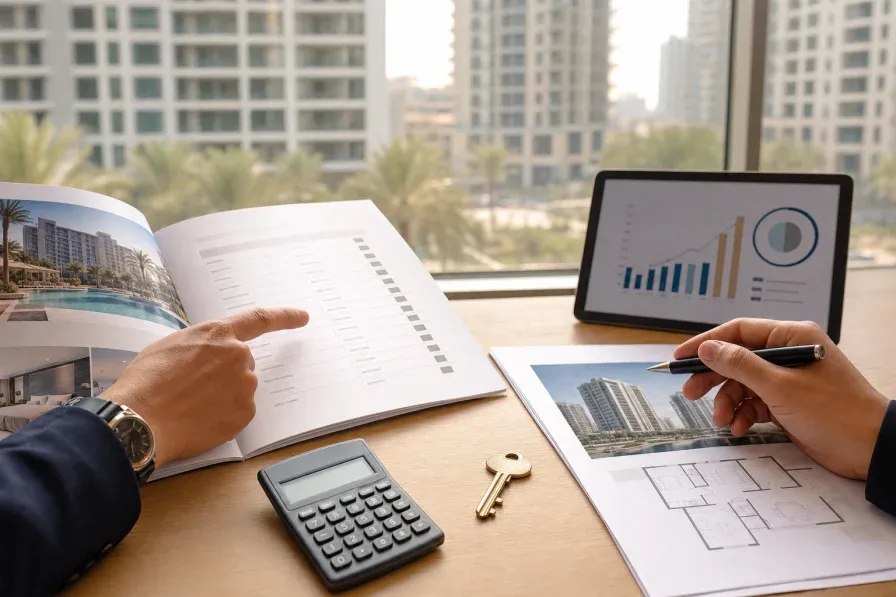
A market catching its breath, not cracking
The headline numbers for the first half of 2026 tell a more layered story than a single direction of travel. According to Dubai Land Department data cited by Financial Express, Dubai recorded 86,005 real estate transactions worth AED 286.43 billion in H1 2026, covering homes, buildings and land. Ready-to-move properties were the single largest slice of that activity, at more than AED 146.7 billion across 27,200 transactions.
At the same time, an ANAROCK report cited in July shows Dubai's residential transaction value fell about 16% year-on-year to roughly AED 225.7 billion, while average residential prices actually rose about 6% to around AED 1,900 per square foot. In other words, fewer or smaller deals took place, but prices themselves held and edged higher. That is a very different picture from a market in retreat.
The backdrop matters. This data lands against ongoing regional tension, and Financial Express interviewed three market figures — Rizwan Sajan of Danube, Prince Dhariwal of NavBharat Niwas and Porush Jhunjhunwala of Banke International — who broadly agree that demand has become more selective rather than absent. Dhariwal frames it neatly: buyers are spending more time on location, developer track record, payment plans and rental income before committing. He calls the shift healthy.
Where the momentum is
The developer league table underlines that confidence hasn't drained away. Gulf News reports that the UAE's top 10 developers sold Dh113.7 billion of property in the six months to end-June. Emaar led with about Dh26.6 billion of total sales (Dh22.4 billion attributable to UAE operations), with its revenue backlog from projects under development at roughly Dh164.9 billion — up 13% year-on-year. DAMAC ranked third with Dh16 billion.
Abu Dhabi's Aldar recorded Dh9.5 billion in UAE development sales, part of Dh12.1 billion group-wide, with international buyers and expatriate residents accounting for 80% of its UAE sales. Aldar's development backlog reached Dh71.6 billion and net profit after tax rose 18% year-on-year to Dh4.9 billion. That level of pre-sold, contracted revenue is a useful signal: it reflects demand already banked, not hoped for.
The off-plan segment remains the engine. Arabian Business, citing market data, notes off-plan accounted for 71% of H1 2026 transactions, driven by branded residences, luxury demand and population growth.
Prices: whose number is right?
The picture on price direction is genuinely mixed across sources, and it is worth being honest about that. ANAROCK shows prices up about 6% year-on-year. Yet Arabian Business, citing REIDIN, recorded a 1.76% monthly decline in Dubai during April, while ValuStrat measured a cumulative 10% reduction from late February to June — even as both retained positive annual growth. Industry reports quoted by Financial Express also point to falls of around 4–7% in some parts of the market between February and April.
These are not necessarily contradictory. Annual growth can stay positive while a short-run correction plays out over a few months, and averages disguise wide variation between prime waterfront stock and secondary locations. The consistent thread is that quality projects in well-connected areas by trusted developers held up best, while thinner segments softened.
Yields, costs and the supply question
For income investors, Arabian Business (citing REIDIN data via eToro's Nagham Hassan) puts Dubai and Abu Dhabi gross apartment yields at 6–7%, falling to nearer 4–5% net once service charges, management fees and vacancy are accounted for. Service charges alone can absorb more than a fifth of annual rental income — a reminder that gross yield is not the number you bank.
Supply is the variable to watch into the next cycle. Arabian Business cites an estimate of roughly 77,500 new homes for Dubai in 2026, with completions projected to rise further in 2027. That new inventory will test absorption, rental growth and delivery schedules — and it is precisely why location, build quality and handover timing will increasingly separate individual projects from the market average.
Financing and buyer behaviour
Crucially, the softer volumes cannot be pinned on borrowing costs. The Central Bank of the UAE held its base rate at 3.65% on 29 July 2026, and mortgage pricing is following global rate trends rather than regional risk. Developers, meanwhile, are responding with flexibility — longer payment periods, post-handover plans and fee waivers — rather than broad price cuts. Danube's 1% monthly plan, Sajan notes, predates the current tensions and is a long-term affordability strategy.
The through-line: capital is still flowing, but with sharper questions attached. Indians made up 22% of Dubai's foreign residential buyers in 2025 and remain engaged — just more discerning. For a market that spent 2024–2025 running hot, a phase where buyers scrutinise developer, location and exit before signing is not a warning sign. It is the market growing up.
I read this as a normalisation, not a downturn. When prices rise ~6% while transaction value cools 16%, you are watching speculative froth thin out while genuine demand holds — exactly the environment where careful buyers do better than the crowd did in 2025. The developer backlogs tell the real story: Emaar's Dh164.9 billion and Aldar's Dh71.6 billion are contracted revenue, not sentiment. My caution is on the price data itself — ANAROCK, REIDIN and ValuStrat point in slightly different directions over different windows, so I trust project-level evidence over the headline average. With 77,500 completions due this year, the gap between well-located, well-built stock and everything else will widen. That is opportunity for disciplined buyers and a trap for anyone chasing a generic 'Dubai is up' narrative.
What this means for investors
The market is rewarding selectivity, and so should you. A cooler volume environment with steady prices means less competition on good stock and more room to negotiate terms — longer payment plans, post-handover schedules, fee waivers — even if headline prices aren't being cut. Focus your capital on established developers with strong delivery records in well-connected locations, because the incoming 77,500-home supply wave will punish weak projects first. Model net yield, not gross: at 6–7% gross falling to 4–5% net, service charges materially change the return. And factor in ~4% transfer costs, which can take a year or two of rent to recover in flat conditions. If you're buying for a Golden Visa, note the threshold is now AED 2 million with stricter off-plan payment conditions.
- Price signals conflict across ANAROCK, REIDIN and ValuStrat, so headline averages may mislead on your specific segment.
- Roughly 77,500 new homes due in 2026 (rising in 2027) could pressure rents and resale values in oversupplied pockets.
- Regional geopolitical tension remains unresolved and could dampen sentiment or lift insurance and construction costs.
- Net yields of 4–5% after service charges and ~4% transfer costs mean returns depend heavily on capital growth, which is cooling.
- The Golden Visa threshold rise to AED 2 million with stricter off-plan payment rules changes the entry maths for residency-driven buyers.
If you're weighing an investment in Dubai or Abu Dhabi, book a consultation or message me directly on WhatsApp — I'll run the same checks you've read here on your specific shortlist.
Not ready for a call? Start with the Investor Diagnostic.
Material claims in this analysis are linked to their underlying sources.
- Is Dubai property losing its shine? Experts weigh in as Indian buyers take a 'risk-aware lens' — Financial Express · 2026-08-19
- UAE real estate investing: Should you buy property or invest in listed real estate shares? — Arabian Business · 2026 (approx. 1 month ago)
- UAE's top 10 developers sell Dh113.7 billion of property in six months — Gulf News · 2026-08-13
Figures are drawn from the sources above and were accurate as of 6 September 2026. This is market commentary, not personal financial advice.